
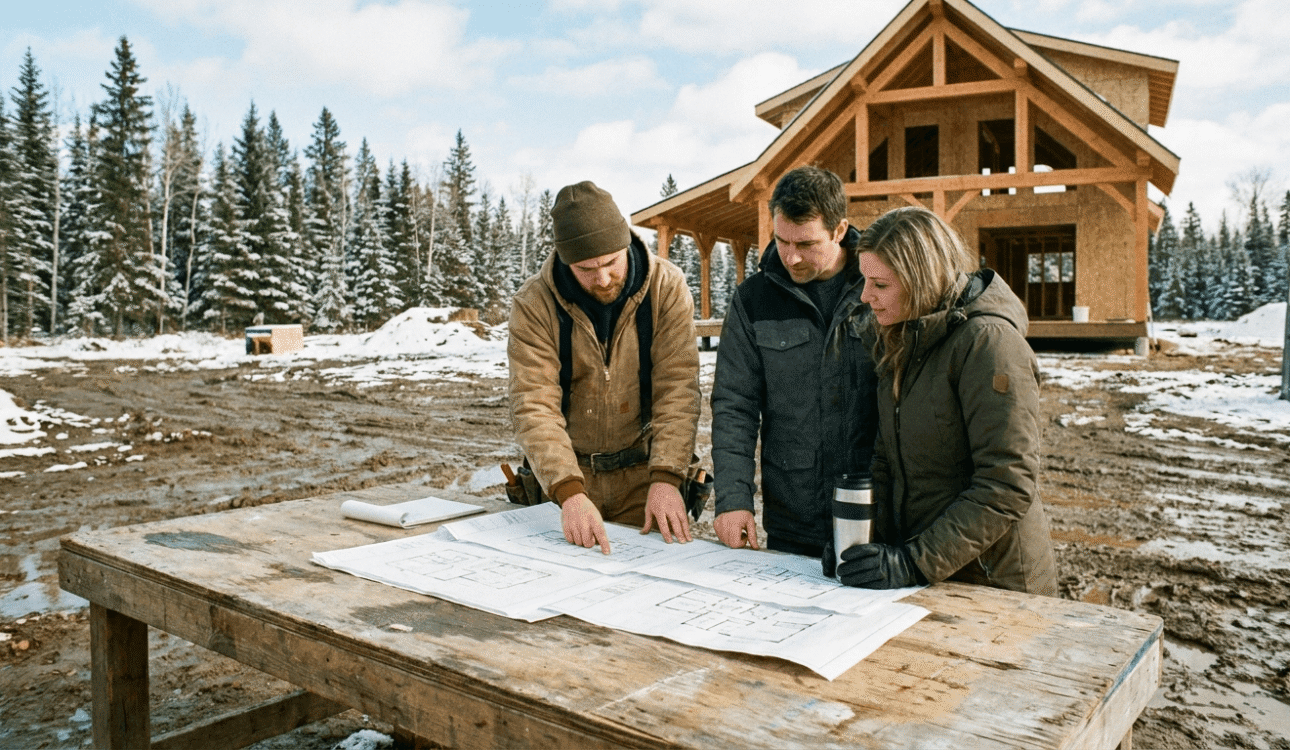
Choosing a home builder is one of the most consequential decisions you’ll make in the whole process. The wrong one costs you money, time, and a lot of stress. The right one makes building a home feel manageable — even enjoyable.
This isn’t a generic checklist you’ve seen before. This is what we’d tell a friend who was starting to shop for a builder in Edmonton right now.
| “The cheapest quote is rarely the best value. And the fanciest showroom isn’t a substitute for a builder who actually communicates.” |
1. Understand What Kind of Builder You Need
Not all builders are the same. Before you start calling anyone, know what you’re looking for:
- Custom builders start from scratch — your lot, your plans, your decisions on everything. More flexibility, more involvement required from you.
- Semi-custom builders start with a library of floor plans you modify. Faster and often less expensive, but less flexibility on layout.
- Volume / production builders build the same home types repeatedly in their own communities. Efficient, but limited customization.
Landry Homes is a custom and semi-custom builder. If you want to make real decisions about your home — layout, finishes, structure — that’s the type of builder you need.
2. Check Licensing and Warranty Coverage
In Alberta, every new home builder must be registered with the Alberta New Home Warranty Program (ANHWP). This isn’t optional — it’s the law. Before you sign anything with any builder, confirm their ANHWP registration.
The ANHWP provides mandatory coverage on every new home: one year on workmanship and materials, two years on mechanical systems, and ten years on structural defects. If a builder isn’t registered, walk away.
Also confirm: full liability insurance and Workers’ Compensation Board (WCB) coverage on all workers and subcontractors on your site. Ask for certificates. Any reputable builder will provide them without hesitation.
3. Ask to See Finished Work — In Person
Photos on a website are curated and edited. If you can, ask to see a completed home in person. Even better, ask if any past clients would be willing to show you their home.
What you’re looking for: consistency in craftsmanship across different areas of the home — not just the kitchen and master bath. Look at the trim details, the caulking lines, the paint edges, the staircase. Quality shows up in the details that aren’t highlighted in the photos.
4. Understand How They Price
This is where a lot of buyers get caught. Ask every builder directly: is this a fixed-price contract or a cost-plus contract?
- You agree on a number before construction starts. Cost overruns (outside of changes you approve) are the builder’s problem.Fixed-price:
- You pay actual costs plus a management fee or percentage. Your exposure is open-ended. Budgets can and do grow.Cost-plus:
Cost-plus isn’t inherently bad, but you need to understand what you’re signing. A lower fixed-price quote almost always beats a cost-plus quote with a lower headline number once the build is done.
5. Ask Who’s Actually Running Your Build
Some builders sell you on the principal, then hand your project to a site supervisor you’ve never met. Ask directly: who is my main point of contact during the build? Who is on site regularly? Who do I call if I have a question or a concern?
At Landry Homes, Jamie runs every build. That’s not a marketing line — it’s how we operate. One phone call gets you the person who knows your project.
6. Read the Contract Carefully
A reputable builder’s contract will be detailed. It should clearly describe:
- What is included in the build scope (and what isn’t — appliances, landscaping, window coverings are often excluded)
- How change orders are handled and priced
- Draw schedule and payment milestones
- Possession date and what happens if it’s missed
- Warranty terms and how deficiencies are handled
If the contract is vague or the builder resists adding detail, that tells you something important.
7. Talk to Past Clients
Ask every builder for references. Then actually call them. Ask: Did the build finish on time? Were there surprises in the final cost? How did the builder communicate during construction? Would you use them again?
One or two glowing testimonials on a website prove nothing. Three or four real conversations with past clients tell you everything.
8. Trust the Conversation
After the licensing, references, and contract review — trust how the initial conversation felt. Did the builder listen? Did they ask questions about your goals, or did they immediately start pitching plans? Were they upfront about costs, or did they deflect?
You’re going to be working with this person for 12–14 months. The relationship matters. A builder who communicates clearly at the start will communicate clearly when things get complicated.
A Simple Checklist Before You Sign
- Confirm ANHWP registration (verify at anhwp.com)
- Request proof of liability insurance and WCB coverage
- Visit at least one completed project
- Get a written fixed-price contract with full scope detail
- Confirm who your main point of contact is during the build
- Call at least two past client references
- Understand what is and isn’t included in the contract price
Ready to Start?
If you’re interviewing builders in Edmonton, we’re happy to be on the list. We’ll answer every question on this checklist — and a few you haven’t thought to ask yet.
Landry Homes builds custom homes across Edmonton, Sherwood Park, St. Albert, Leduc, and surrounding communities.
Let’s talk about your build.
☎ 780-257-8642 | jamie@landryhomes.ca | Book a Free Consultation →


