
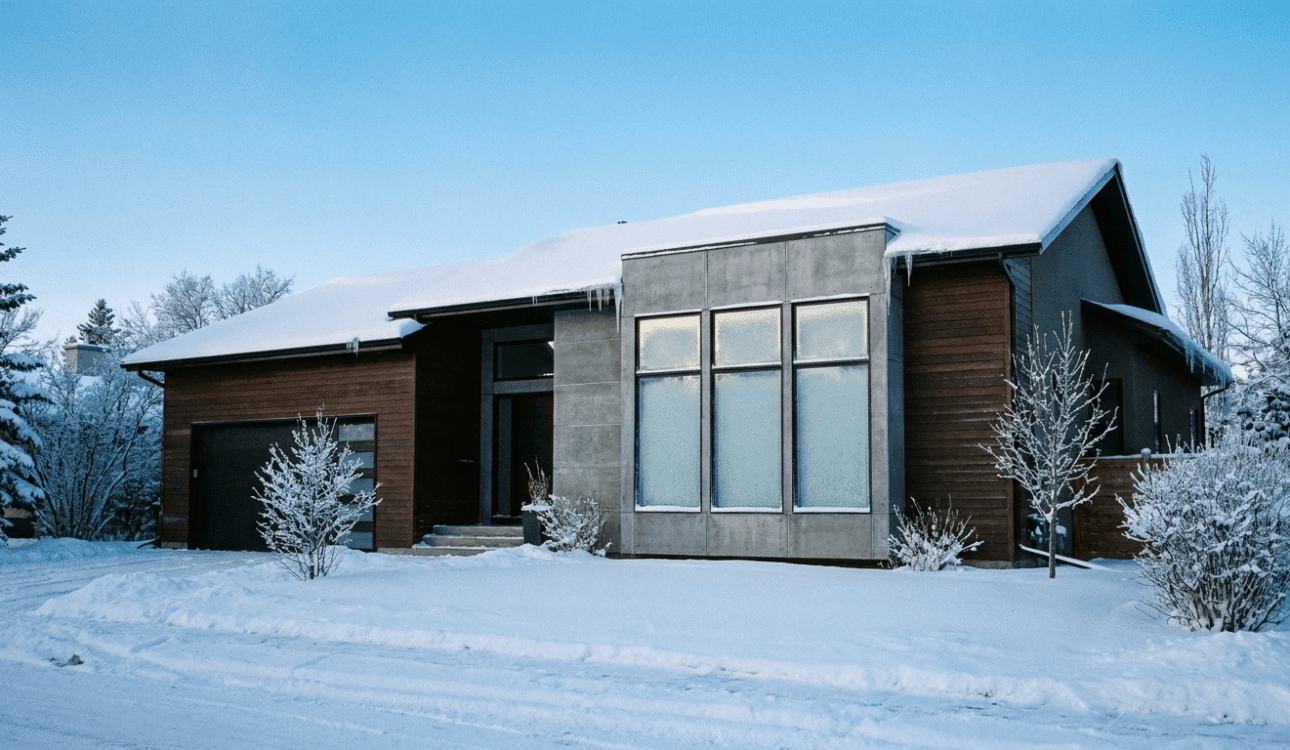
Edmonton’s climate is one of the most demanding in Canada for residential construction. We’re talking about a city where temperatures can hit -40°C in January and +35°C in July — a swing of 75 degrees over the course of a year. Add in significant freeze-thaw cycling in spring and fall, heavy snow loads, and persistent wind, and you have a set of construction conditions that most national building standards barely address.
The homes we build in Edmonton have to perform in this environment for 50+ years. That means the decisions made in design and construction — wall assemblies, insulation specs, foundation details, roofing choices — matter more here than in almost any other Canadian city.
| “Building to code in Alberta is a floor, not a ceiling. The minimum gets you a compliant home. A well-specced home built for Edmonton’s climate gets you one that performs for decades.” |
Foundation: Going Deeper Because We Have To
Edmonton’s frost line — the depth at which the ground freezes — sits at approximately 1.8 to 2.0 metres (about 6 feet). Every foundation must be built below this depth to prevent frost heave — the expansion and contraction of frozen ground that can crack and shift a foundation over time.
This isn’t negotiable and it isn’t optional. What it means practically: excavation in Edmonton is deeper and more costly than in milder climates. It also means more concrete, more formwork, and more time before framing can begin.
What to ask your builder: Are you using poured concrete or ICF (insulated concrete forms) for the foundation? ICF adds R-value to the foundation walls, which is particularly valuable in Edmonton’s climate and can make a meaningful difference in heating costs over the life of the home.
Wall Assemblies: Insulation Is Not an Upgrade
Alberta’s Building Code requires a minimum of R-20 in above-grade walls. In Edmonton’s climate, that’s adequate — but not impressive.
At Landry Homes, we build to higher thermal values by default. R-24 to R-28 wall assemblies are achievable with the right combination of batt insulation and exterior continuous insulation — and the ongoing energy savings make the modest upfront cost very worthwhile.
The other critical detail in Edmonton wall assemblies: the vapour barrier. In a cold climate, moisture management inside the wall cavity is essential. Improper vapour barrier installation leads to condensation, mould, and structural damage — problems that show up years after construction and are expensive to fix.
Windows: The Biggest Thermal Weakness in Any Home
Windows are the lowest-performing element in a home’s envelope. Even a high-quality window loses more heat per square foot than any insulated wall. In Edmonton, this matters.
Minimum spec for Edmonton builds: triple-pane glazing with low-E coatings and argon fill. The additional upfront cost over double-pane pays back in comfort and energy savings within a few years — particularly for west and north-facing windows that take the brunt of winter winds.
Watch for: builders who spec double-pane windows to hit a lower price point. Ask specifically what glazing specification is in your contract before you sign.
Roofing: Snow Load and Ice Damming
Edmonton’s average snow load is significant enough that roof trusses must be engineered to carry the accumulation of a heavy snowfall season — not just the annual average.
Ice damming is the other concern: when heat escapes through a poorly insulated attic, it melts snow near the ridge. That water runs down the roof and refreezes at the colder eaves — creating ice dams that force water under shingles and into the structure. Prevention is straightforward: proper attic insulation (minimum R-60 in attic assemblies) and ventilation to keep the roof deck cold and even-temperatured.
For flat or low-slope roofs (common in contemporary designs), proper drainage design and membrane selection for cold climates is critical. A flat roof spec appropriate for Vancouver will fail in Edmonton.
Heating Systems: Sized for -40
An undersized furnace in Edmonton isn’t just uncomfortable — it’s a safety issue in extended cold snaps. Every mechanical system in a Landry Homes build is sized based on a proper heat loss calculation for the specific home design, not generic square footage rules of thumb.
The HRV (heat recovery ventilator) is mandatory in Alberta and essential in Edmonton’s climate. Tightly built, well-insulated homes — which is what you want — don’t breathe naturally. The HRV provides controlled fresh air while recovering most of the heat from the exhaust air. Without one, indoor air quality suffers. With one, you get a comfortable, healthy, efficient home.
Exterior Materials: What Performs and What Doesn’t
- Durable in Edmonton’s climate, holds colour well, and handles freeze-thaw without significant cracking. Lower maintenance. Less premium appearance.Vinyl siding:
- Excellent durability, holds paint well, and is not susceptible to moisture damage or freeze-thaw cracking when properly installed. Our recommended mid-to-premium siding option.James Hardie fibre cement:
- Beautiful but requires regular maintenance in Edmonton’s climate. Staining every 3–5 years is realistic. Properly installed and maintained, it performs well.Wood siding:
- Common in Edmonton and appropriate, but requires a well-detailed drainage plane behind it. Stucco failures in Alberta are almost always installation failures, not material failures.Stucco:
- Excellent durability as an accent material. Full stone is expensive and heavy but performs very well.Stone veneer:
Building in Winter: What Actually Happens
We build year-round in Edmonton. Winter construction is standard in this market — not exceptional. Here’s what it involves:
- Concrete pours below -10°C require heated enclosures and insulated curing blankets. This adds cost and time but is standard practice.
- Framing in winter is generally fine. Lumber performs normally in cold temperatures, and construction heating units keep interior spaces workable.
- Exterior cladding, roofing, and painting have temperature minimums specified by the manufacturer. Experienced builders schedule these trades within weather windows or use appropriate cold-weather products.
A build that starts in September will have foundation work and framing in the fall, with rough-ins and drywalling happening through the winter months — which is perfectly workable.
Ready to Start?
If you’re planning a custom home in Edmonton, the decisions that protect your family’s comfort and your investment start in the design and specification phase — before a shovel hits the ground. That’s exactly what we work through with you in a consultation.
Landry Homes builds custom homes designed for Edmonton’s climate — properly specced, properly built, and built to last.
Let’s talk about your build.
☎ 780-257-8642 | jamie@landryhomes.ca | Book a Free Consultation →


