
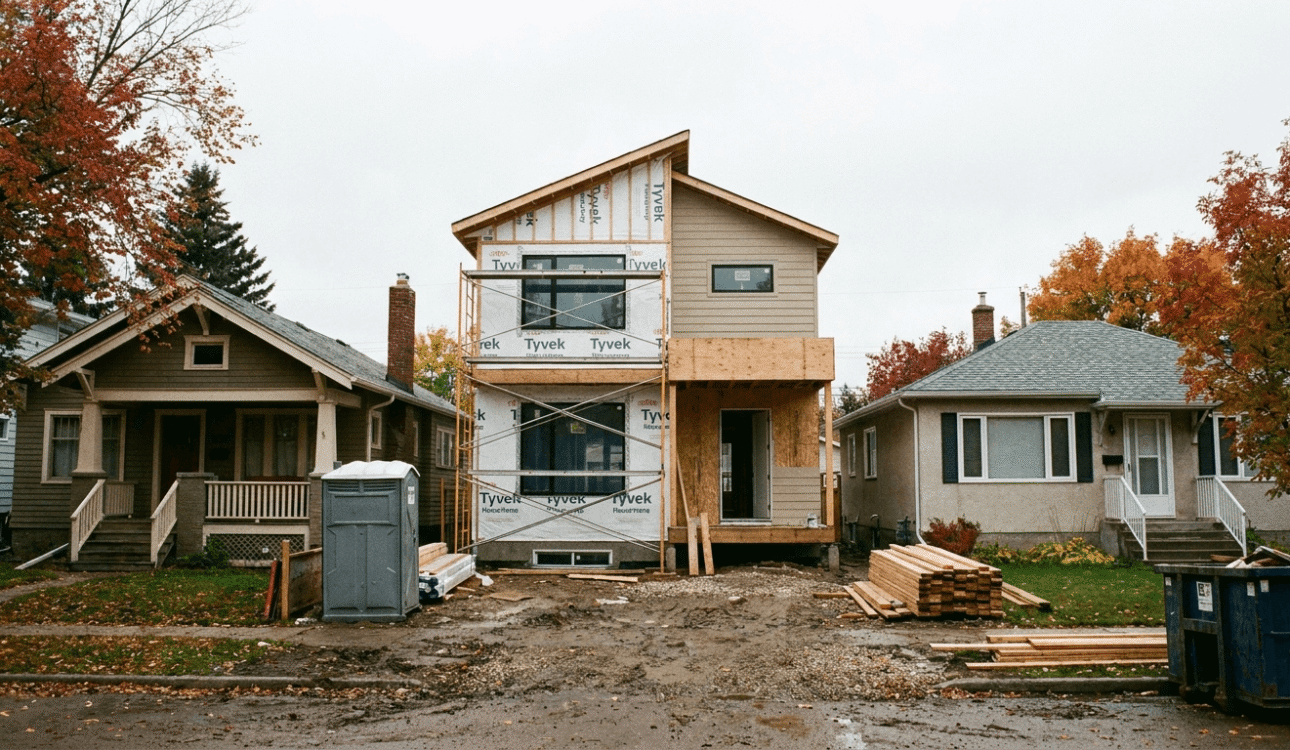
Infill development is one of the most misunderstood parts of Edmonton’s housing market. The idea is straightforward: tear down an older home on an existing city lot, and build a new one (or two) in its place. The execution is anything but simple.
Done right, infill gives you a brand-new custom home in an established neighbourhood with mature trees, walkable streets, and proximity to the city core. Done wrong, it’s a costly, permit-heavy process that drags on far longer than expected.
We’ve built infills in Edmonton. This is what you need to know before you go down that road.
| “Infill lots cost more and take longer to develop than new community lots. The trade-off is location, lot maturity, and access to established neighbourhoods that newer developments can’t replicate.” |
What Is Infill Development?
Infill development in Edmonton refers to building new residential units on existing lots in established neighbourhoods — as opposed to building in newly developed communities on the city’s edge.
The most common infill formats in Edmonton:
- Single detached infill — one new home on a lot where an older home was demolished
- Skinny homes / side-by-sides — a standard lot is subdivided into two narrower lots, each with a new home
- Row housing infill — multiple attached units on a larger lot or multiple lots
- Semi-detached / duplexes — two units sharing a wall on a single lot
Each format has different zoning requirements, subdivision rules, and construction implications.
Edmonton’s Infill Bylaws: What You’re Working With
Edmonton’s Zoning Bylaw 20001 (the current bylaw) governs infill development. The key rules that affect most infill builds:
Lot width and size minimums
The minimum lot width for a single detached home in most residential zones is 7.5 to 10 metres (approximately 25–33 ft), depending on the zone. Subdivision for side-by-sides requires each resulting lot to meet this minimum.
Front and rear setbacks
Infill homes must respect front yard setbacks based on the average of adjacent homes on the block face — not a fixed number. This can create interesting design constraints depending on your neighbours’ setbacks.
Height restrictions
Most infill zones in Edmonton limit single detached homes to 8.9 metres (approximately 29 ft) in height. Design your roofline accordingly.
Garage and accessory structures
Detached garages on infill lots are permitted but must meet their own setback and height requirements. Secondary suites (basement or garage suites) are permitted in most infill zones with proper registration.
The Infill Process: Step by Step
- Lot evaluation — we review zoning, setbacks, utilities, and subdivision potential before you commit to purchasing
- Demolition permit and demo — the existing structure must be properly demolished, with utility disconnection before work begins
- Subdivision application (if applicable) — if you’re splitting the lot, this adds 6–12 weeks to the pre-construction timeline
- Development permit application — submitted to the City of Edmonton with full site plan and architectural drawings
- Building permit application — follows development permit approval; review takes 4–8 weeks
- Construction — similar to any custom build, 10–14 months from permit approval
- Final inspection and occupancy permit
Total timeline from lot purchase to possession on an infill: typically 18–26 months, depending on subdivision requirements and permit timelines. This is longer than a new community build. Plan accordingly.
Infill Lot Costs in Edmonton
Infill lot prices in Edmonton vary enormously by neighbourhood. Here’s a realistic range in 2025:
- $280,000–$500,000+Mature inner-city neighbourhoods (Glenora, Westmount, Bonnie Doon, Strathcona):
- $200,000–$320,000Mid-ring established neighbourhoods (Hazeldean, Pleasantview, Duggan):
- $160,000–$240,000Outer established areas (Lago Lindo, Brintnell, Ellerslie):
The lot cost is typically the largest line item in an infill build. At $400,000 for a lot plus $550,000 in construction, you’re looking at a $950,000+ finished home — but in a neighbourhood you couldn’t access any other way.
What Makes Infill Harder Than New Community Builds
- Tight lots and access constraints make material delivery and staging more difficult — and sometimes more expensive.
- Neighbours are closer and more protective of their views, sunlight, and privacy — design accordingly.
- Mature trees on or near the lot can create root conflicts with foundation excavation and require arborist reports.
- Older utility services (water, sewer, gas) may need upgrading to the lot line at your cost.
- Neighbouring property owners have notification rights during development permit review and can formally object.
None of these are dealbreakers. They’re things an experienced infill builder manages routinely. If your builder has never done an infill in an established Edmonton neighbourhood, this is not the project to learn on.
Is Infill Right for You?
Infill makes the most sense when:
- You want a specific neighbourhood that doesn’t have new community lots available
- You value walkability, mature trees, and proximity to the urban core over lot size and newness
- You have a longer runway — 18–26 months is realistic, and you can’t rush permits
- Your budget accommodates premium lot costs
It’s likely not the right fit if you need to move quickly, have a tight budget, or want a large lot.
Ready to Start?
If you’re looking at an infill lot in Edmonton and want a realistic assessment before you commit — that’s exactly what we do in an initial consultation. No cost, no pressure.
Landry Homes builds custom homes and infills across Edmonton’s established neighbourhoods and surrounding communities.
Let’s talk about your build.
☎ 780-257-8642 | jamie@landryhomes.ca | Book a Free Consultation →


